Wild dog fencing in NSW: what the duty says
Landholders in NSW have a duty to control pest animals on their land, and NSW Government guidance recommends boundary fencing as one way to keep them out. For wild dogs, the Government lists fencing among several control methods, alongside baiting, trapping and shooting. So fencing is one tool and not the whole answer. This guide explains the duty, shows where fencing fits and gives you questions for a contractor who is asked to build an exclusion fence.
We are a referral service. Your enquiry is passed to a local contractor, and nothing here is advice on a particular pest or property. For that, ask Local Land Services.
The general biosecurity duty in plain words
The NSW Government's general biosecurity duty page says that anyone who deals with biosecurity matter, and who knows or ought reasonably to know of the risk, has a duty to take reasonably practicable steps to prevent, eliminate or minimise that risk. The same page says you have a duty to control pest animals on your land. In practice that means the duty is about what you can reasonably do, and it can include keeping animals out as well as dealing with them once they are in (NSW Government general biosecurity duty page).
The page does not set a fence standard. It recommends boundary fencing and stops there. So whether a fence helps on your property, and what kind, is a question for the contractor and for Local Land Services.
Where fencing fits among wild dog controls
The NSW Government wild dog page says control methods include ground baiting, aerial baiting, trapping, shooting and fencing. It says private and public landowners and managers must control wild dogs, and that the occupier must take every practical step to limit the harm they could do. It also says the wild dog is a priority pest in all 11 regional strategic pest animal management plans (NSW Environment and Heritage).
Two things follow. First, fencing is named as a method, which is different from saying it works on every property. Second, the duty falls on the occupier, so the choice of fence is yours to make with advice. Ask what the fence is meant to keep out, how it will be checked and what happens when it is breached. We found no source that gives wild dog pressure by town or says how well a fence performs, so we make no claim about either.
Wild dogs are a live topic in the foothills country. A regional newspaper report in 2019, a secondary source, quoted farmers saying an interstate dog fence upgrade does little for the Riverina wild dog problem (regional newspaper report). That is the farmers' view as reported, and we do not draw a conclusion from it. See the Tumut and Snowy Valleys page for the area.
Exclusion fencing and what it means
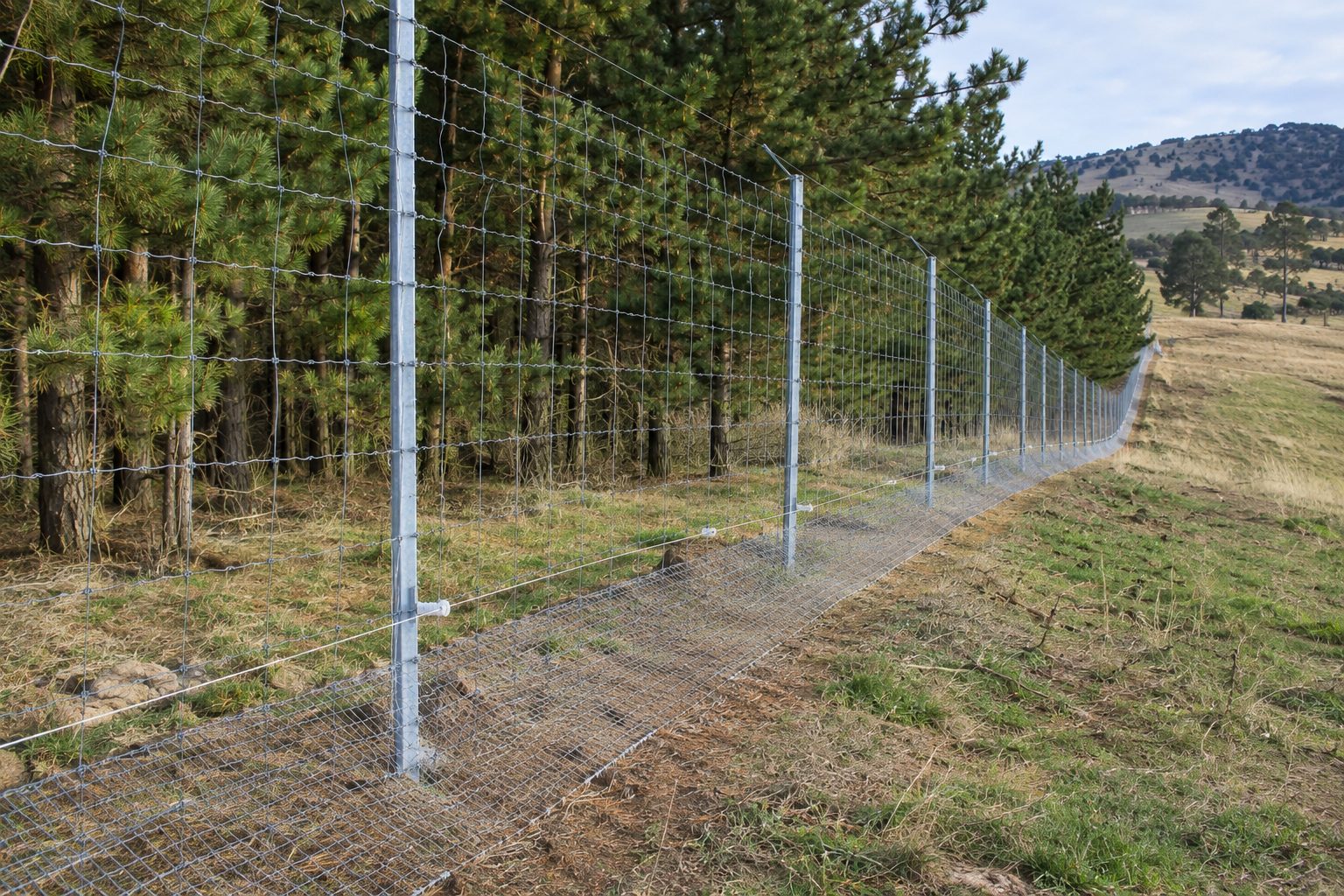
An exclusion fence is built to keep an animal out, not to hold stock in. Designs differ with the animal, and the Queensland design below includes netting buried at the base. The contractor decides the design, so describe the animal you are trying to exclude and ask for the design in writing. If the same fence must hold stock as well, say so. The sheep and cattle fencing page covers stock wire and mesh.
One Queensland design, for illustration only
To show what a pest fence specification can look like, here is one Queensland Government rabbit fence design. It is a Queensland design and not a NSW standard, and we use it only as an illustration (Queensland Government rabbit fence design page).
| Part of the design | What the Queensland page lists |
|---|---|
| Rabbit netting | 90 x 4 x 1.4, as the design labels it |
| Foot netting | 30 x 4 x 1.4, buried at least 150 mm |
| Top of the netting | 960 mm above the ground |
| Wooden posts | 600 mm in the ground, 4 m apart |
| Strainers | 900 mm, with 100 m between strainers |
Nothing here tells you what to build in NSW. Dimensions for a fence on your land depend on the animal, the ground and the contractor's method. Use the table to see the kind of detail a design page can carry, then ask your contractor for the same detail.
Funding: why rounds come and go
Funding for pest fencing has come in rounds tied to particular projects. A Local Land Services fencing project in the Western region, run to establish biosecure production zones and knock out pests, is listed as completed. It covered nine projects, 376 km of fencing and 331,170 ha, and it was in the Western region, not the Riverina (Local Land Services project page). We did not find current Local Land Services fencing funding for the Riverina, so do not assume any is open.
That is why rounds seem to appear and vanish: each one is tied to a project, an area and a closing point. Ask Local Land Services what is open now. The fence assistance page covers help after floods and fires, which is a separate matter.
What to ask a contractor about a pest fence
- What animal is the fence designed to keep out?
- What height, netting and apron does the design use, and why?
- How will it be checked after floods, storms and stock pressure?
- How are gates, creek crossings and corners handled?
- What does the quote assume about access and machinery?
When you are ready, send the town, the fence length and a description of the problem.
What this guide cannot do
This guide cannot tell you what your general biosecurity duty requires on your property, whether a fence will keep a given pest out or whether any funding is open. The sources we read describe the duty and the control methods in general terms, and they give no standard for a pest fence in NSW.
We are a referral service. Your enquiry is passed to a local contractor, who sets their own design and terms, and we do not quote, build or sign contracts. Ask Local Land Services about your duty and about pest control on your land.
Check the current rules before you rely on this
This page describes the general biosecurity duty, where fencing sits among wild dog controls and how funding rounds work. It describes the rules in general terms as they stood in November 2026. Standards, forms, thresholds and fines change.
The authoritative sources are NSW Government, general biosecurity duty, NSW Environment and Heritage, wild dogs, Local Land Services, Fencing Biosecure Production Zones and Pest Knockout project (completed; Western region) and Queensland Government, rabbit fence design (a Queensland design, not a NSW standard). Where anything here differs from those sources, they are right and we are not.
We are not fencing contractors, builders, regulators or lawyers. For what applies to your land, ask Local Land Services about your biosecurity duty and pest control, and ask the contractor what design they would build and why.
Accurate at the time of writing, November 2026. Always check the source before relying on it.