Flood damaged fence repair: where to start
Flood damaged fence repair starts before anyone picks up a tool. Photograph the fence where it lies, note the date and the height the water reached, and keep the pictures. Then decide what is urgent, such as stock getting out, and what can wait for a proper assessment. Fire damage is similar: record first, then repair or rebuild. This site is a referral service. Your enquiry is passed to a local contractor, who does the work and is responsible for holding any licence or registration that applies.
This page is about the repair job and the design choices. Help with the cost is a separate subject, covered on the assistance page, which carries no amounts or dates.
First steps after floodwater, debris or storm
- Photograph before you clean up. Take wide shots of the line and close shots of posts, strainers, gates and the debris caught on the wires. Legal Aid NSW advises keeping photos where a fence is damaged.
- Make stock safe. Decide what has to be held, and ask the contractor what can be done quickly to hold it.
- Stay clear of powerlines. The regional electricity network operator's guide says to stay at least 8 m from a line and anything touching it. A fallen tree or branch on a fence can be touching one.
- Note who is on the other side. A neighbour, a road, a reserve or Crown land all change who you talk to.
If the fence is a shared boundary, urgent repairs may go ahead without a notice, according to Legal Aid NSW. Work that is later found not to be urgent can cost you the neighbour's contribution, so record why it could not wait.
Who pays when a shared fence is damaged
The Dividing Fences Act 1991, in the version we found dated 7 December 2024, covers urgent work on a damaged or destroyed fence and can share it, and it lets an owner seek more where someone damaged a fence by negligence or on purpose. We did not find how the Act treats flood or fire damage, and no source we read settles it. Ask a solicitor, or the court or tribunal. Sources disagree on the forum. The dividing fences guide has the process, and you can check the current Act on legislation.nsw.gov.au.
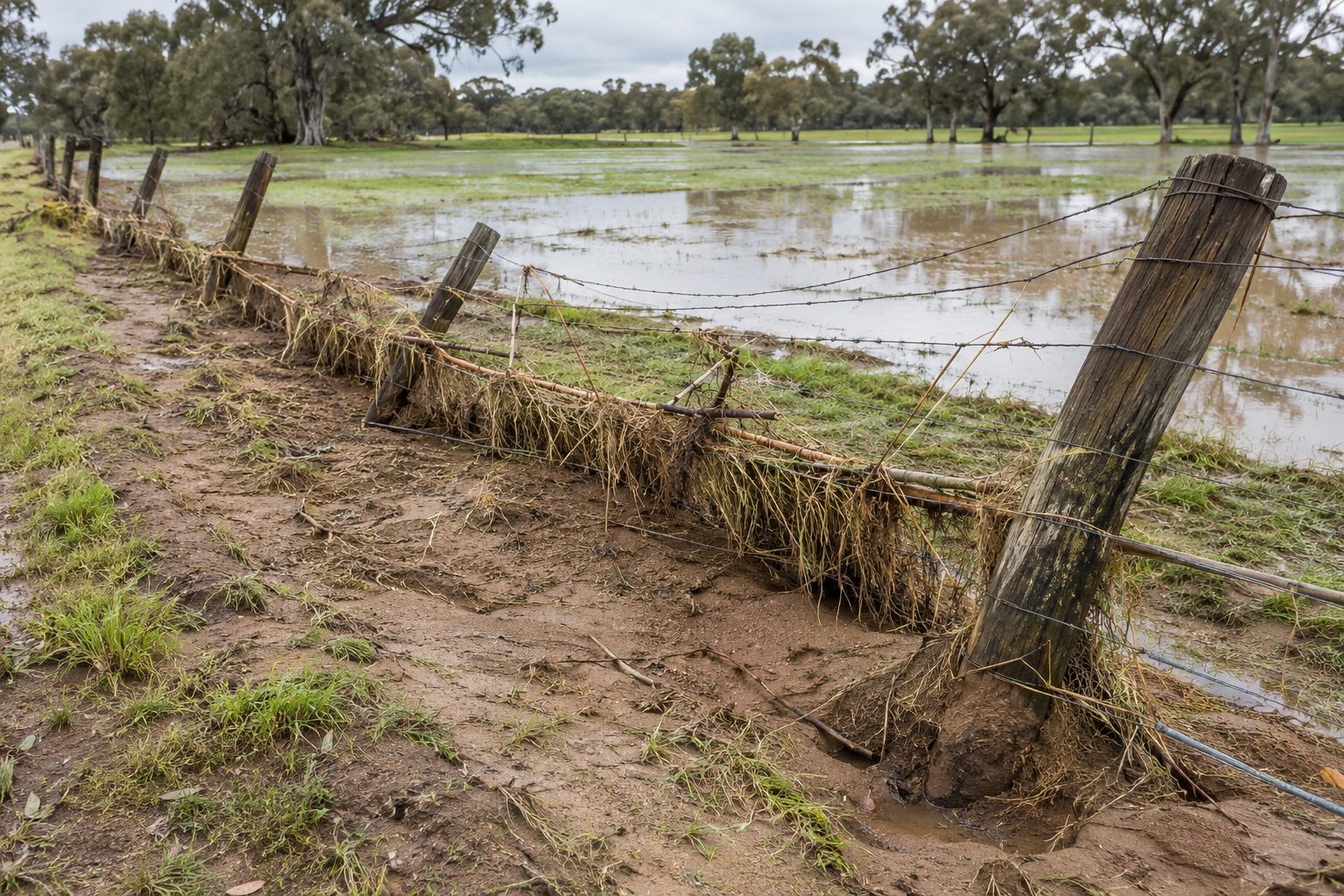
What flood-prone fencing guidance suggests
Victorian Government guidance for riparian fences in flood-prone areas, an interstate source, is written for fences along waterways, not for every paddock fence. It starts from a hard fact: no fence can be designed to withstand a major flood. What it offers instead is a set of ideas for fences that cope better or are easier to put back. Treat them as one source of ideas, and ask the contractor what suits your land.
| Idea in the guidance | What it means for your enquiry |
|---|---|
| Align the fence no more than 45 degrees to the flow path | Say which way water runs across the line. |
| Drop-down or lay-down fences for sudden floods | Ask whether your site could suit one. |
| Keep strainer assemblies independent | Ask how the ends are built so one failure does not pull the line. |
| Plain wire is easier to clean up and re-strain than mesh or barbed wire | Ask which wire is quoted and why. |
| Avoid mesh and barbed wire in flood-prone areas | Weigh this against the stock the fence must hold. |
| Keep fences as low as adequate for livestock control, generally 1.2 m to 1.4 m | Ask what height is proposed. |
| Put gates on high ground, parallel to the flow | Say where the high ground is. |
The guidance also says electric fences are often the best choice in flood-prone areas, because fewer wires catch less debris. The electric fencing page covers the parts and the questions to ask.
A Landcare group has built a swinging flood fence, a boundary fence designed to swing with floodwater and return afterwards (a Landcare group's design). The page gives no specifications, so it is illustrative only.
Soil, strainers and re-straining
Soil type and wetting and drying affect how posts and strainers behave. A 1963 CSIRO abstract (an old abstract on Riverine Plain soils) describes cracking in Riverine Plain soils, linked to wetting and drying, but it says nothing about fence posts. So ask the contractor how they will set strainers on your soil, whether sound posts can be re-used after the water has gone, and who removes the debris. Ask for re-straining to be shown as its own line in the quote.
Repairing after a fire
For a fire damaged fence rebuild, the first questions are about permits and safety. NSW Rural Fire Service says fire permits are free, should be requested 24 hours ahead, and are tied to the Bush Fire Danger Period, which runs from 1 October to 31 March but can vary from season to season. Permits last up to a maximum length. We found nothing on welding, grinding or other hot work on fence lines, so check current fire danger rules for your area and ask the contractor how they plan around fire danger days.
Around Tumut, Tumbarumba, Adelong and Batlow, the district information pack (Rural Fire Service district pack) records about 66 bush fires a year, about 4 significant ones on average, and a season running roughly November to March. See the Tumut and Snowy Valleys page. On the flat irrigated country, see the Deniliquin page for the floodplain side of the question.
What to ask the contractor
Ask for an assessment of what can be saved and what must be replaced, how debris will be cleared, how the line will be re-strained, and whether any rebuild changes the wire, posts or ends. Ask who arranges powerline and underground service checks. Ask for a written, itemised quote, and for the licence and insurance details the contractor says apply. The contractor guide has the full list. If cost is the pressure point, look at the assistance page before you sign anything.
What this page cannot do
It cannot inspect damage, say whether a post can be re-used, design a fence that survives a flood or tell you who pays when a shared fence is damaged by flood or fire, because no source we read settles that. It cannot say whether a fire permit is needed for a particular job, which belongs to the NSW Rural Fire Service. It cannot tell you which licence or registration a contractor holds, or whether one applies to repair work. The flood design ideas come from interstate guidance and are not a New South Wales standard.
Check the current rules before you rely on this
This page describes the first steps after flood or fire damage, what interstate flood guidance suggests and what the Rural Fire Service says about permits. It describes the rules in general terms as they stood in November 2026. Standards, forms, thresholds and fines change.
The authoritative sources are Victorian Government, guidelines for riparian fencing in flood-prone areas (2015; Victorian guidance, interstate), Western Landcare NSW, swinging flood fence (a Landcare group's design; no specifications), Legal Aid NSW, fences, boundaries and retaining walls FAQs, NSW Rural Fire Service, fire permits information for rural landholders and farmers (PDF) and NSW Rural Fire Service, Riverina Highlands district information pack (PDF). Where anything here differs from those sources, they are right and we are not.
We are not fencing contractors, builders, regulators or lawyers. For what applies to your fence, ask the contractor which licence or registration they hold for your job, then ask NSW Fair Trading or Building Commission NSW if you are unsure. For fire permits and current fire danger rules, ask the NSW Rural Fire Service, and ask the council that covers the land.
Accurate at the time of writing, November 2026. Always check the source before relying on it.